
have you ever thought about how you think?
that’s not a trick question.
thinking is a skill, & if you don’t know how to do it ‘properly,’ it’s like going through life blind.
but nobody ever teaches you how to do it — so i will.
here’s 8 things i think i know about how to think:
this shit is really important
how you think determines what you do.
what you do determines almost everything about your life.
therefore, if you want a better life, i’d suggest prioritizing mental clarity over everything else.
mental clarity = the ratio of useful information to useless information that your brain is working with at any given time
i’ll define useful/useless information as anything that, if acted upon, brings you closer/further from your goals, respectively.
the more useful information you have, the more likely you are to behave in a way that brings you closer to your goals.
so that means if the opposite of mental clarity is ‘brain fog,’ your goal is to give your brain as many clear, sunny days as possible.
but how do you do that?
defining terms (see directly above lol)
you can’t think clearly about something if you don’t even know what it is.
in my life, most arguments, mistakes, & wasted time/energy have come from shitty definitions.
so like, everybody wants to be successful, but what is your definition of ‘success?’
the broke, happy monk, & the rich, unhappy banker both feel successful.
so who’s right?
the answer: both of them, & neither of them. it depends how you define success.
define every word that you use, & you’ll realize how few people actually do so.
ok — but how do you do that?
clarity of writing = clarity of thought
if you want to be stronger, go to the gym. if you want to think clearer, write.
the main reason i write is to learn.
that’s because when i force myself to put my thoughts on a page in front of me, it’s really easy to see where i might be wrong & to notice patterns in how i think.
but why is that so important?
the goal is simple: truth
if we take things to a logical extreme here, the smartest, most powerful, God-like being in the universe would be ‘all-knowing.’
not ‘all-thinking’ or ‘all-assuming.’
all-knowing.
but what does that even mean?
knowing = having enough information to make predictions that can be proven wrong by reality, but are still proven right.
so in simpler terms, if nothing could ever prove your idea wrong, you don’t know if it’s true — you just believe it’s true.
for example, “i would’ve gone pro if i didn’t injure my knee” can never be proven wrong since you can’t split test reality. therefore, it’s not a truth, it’s a belief.
but if your idea survives every hard test that can disprove it, then you know it’s true.
for example, “knee injuries significantly decrease the odds of going pro” can be tested against real-world data, like pre vs post injury stats. if the pattern sticks over enough tests, you can be pretty confident that you know the truth.
but isn’t ignorance bliss?
why does knowing the truth even matter in the first place?
first-principles thinking
this is the good stuff here — discovering it changed my life.
if you look at everything we think we know about the world & boil it down to what is fundamentally true (i.e. stuff that can be proven wrong but has never been proven wrong after trying everything else), you realize that most of the things that people claim to ‘know’ are just beliefs.
that means if you can cut through the bullshit, you can unlock these massive opportunities that are invisible to most people.
this point is super important, so i want to drive it home with some examples:
why planes exist:
traditional thinking —> humans can’t fly
first principles thinking —> other animals fly. so is flight impossible, or do we just lack the technology for it right now?
why cars exist:
traditional thinking —> a carriage needs a horse to move
first principles thinking —> movement = converting energy into motion. so can we just replace the horse’s energy with mechanical energy instead?
why phones exist:
traditional thinking —> you can’t talk to people you aren’t physically near
first principles thinking —> sound = vibration. so can vibration be turned into an electrical signal and back again?
the list goes on & on.
one of my favourite quotes from Steve Jobs kinda ties in here:
“everything around you that you call life was made up by people that were no smarter than you.”
there’s just one thing i’d add:
the only difference is that, instead of accepting things as ‘impossible’ like everyone else did, they questioned it, stripped it down to first principles, and rebuilt it from the ground up.
now, you might have to take care of some other things before inventing the next iPhone or airplane. but that doesn’t mean first-principles thinking can’t help you.
here are some real examples of how i used it to change my own life:
why i work for myself
traditional thinking —> you need a job to earn money
first principles thinking —> money = stored value. therefore, if i can figure out a way to create more value for people on my own than it costs me to deliver it, i’ll earn money without a job.
why i’m always honest, with no exceptions
traditional thinking —> sometimes you need to lie
first principles thinking —> trust is at the core of every good relationship in my life. lying erodes trust. therefore, if i value my relationships (i.e. with others & with myself), i will never lie with my words OR my actions.
why i haven’t had a ‘bad day’ in several years
traditional thinking —> some days are just bad days, & that’s ok
first principles thinking —> life isn’t naturally ‘good’ or ‘bad’ — it just exists, & we label things as one or the other before responding to them. but since i can control how i label things, as well as how i act in response to them, i can therefore control if my day will be ‘good’ or ‘bad.’ i choose to have good days.
i could talk about this stuff forever, but i’ll finish here with one final cherry on top:
the only thing you can be certain of knowing is that you don’t know shit
i enjoy writing things like this because it helps me process my own thoughts, & it (hopefully) helps you learn something new that can make your life better.
but as nice as it is to organize complicated things into simple lists with easy words, it can also be a trap.
that’s because the more you know, the smarter you feel.
& if you’re not careful,
the smarter you feel, the dumber you are.
so if you take nothing else away from this, please just remember that we’re all dumb little monkeys who might be a bit too smart for our own good.
control what you can control.
learn how to think.
& then keep learning, because we’re probably all wrong.
some things i learned (lol convenient eh?)
optimism is associated with a longer life
obviously, correlation is not causation, & i wholeheartedly reject the idea that you can just wish things into existence without action (i.e. manifestation). but still, this study supports the idea that your thoughts play a massive role in the outcomes of your life. & hey — even if it’s bullshit & you don’t live longer, a life full of optimism seems better than a life full of pessimism.the true cost of doomscrolling
after a few successful ‘phone-free’ experiments, i’ve completely quit using my phone. i’ll write a full guide for you in the near future, but for now, here’s the exact moment in my journal when things clicked:
“simply put, if i want to achieve my goals, there’s a cost to pay. in this case, i must sacrifice the comfort & convenience that my phone brings me in order to work as much as i want/need to succeed. is that a cost i’m willing to pay? absolutely.”an old Mongolian proverb: “a tiger wearing a bell will starve.”
basically, never let them see you coming. this reminded me of another proverb: “real Gs move in silence like lasagna.” pretty sure Julius Caesar said that. please don’t fact-check me.
cool stuff i found
if you’re not looking at the stars on October 21st, you’re wasting time
that’s because you should be able to see 2 really cool things: (1) the Orionids meteor shower, which NASA described as “one of the most beautiful showers of the year,” & (2) Comet Lemmon, which is a massive ball of ice in space that leaves a huge blue trail behind it. what an awesome day for space nerds.the best productivity tool of all time
since going phone-free, i’ve been using a small (<4’ tall) dot grid notebook every day to write my to-do’s, ideas, & anything else worth noting. it’s crazy what a difference it makes to just physically write down what you want to do each day. pic for reference, but just get the best cheap option you can find.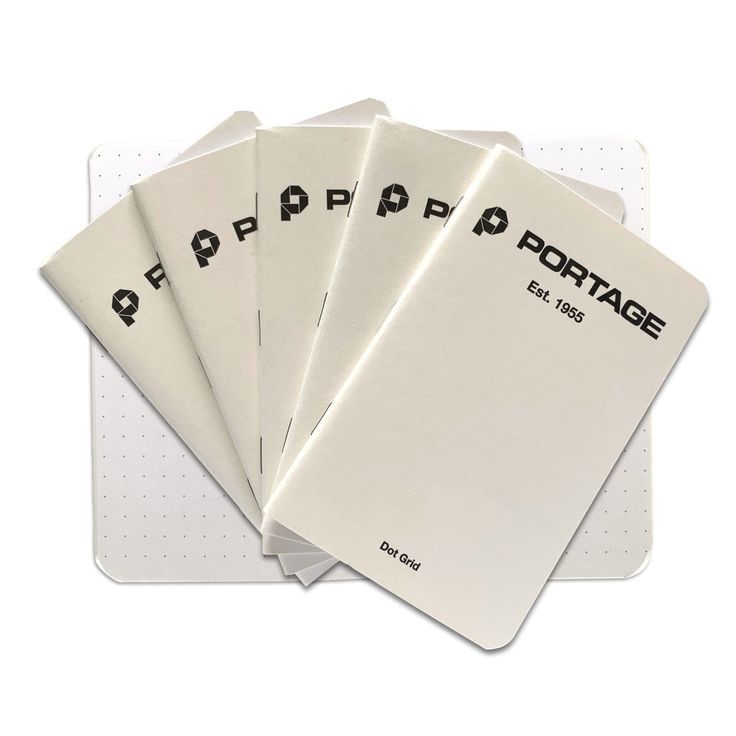
why i don’t pay attention to the news, explained by
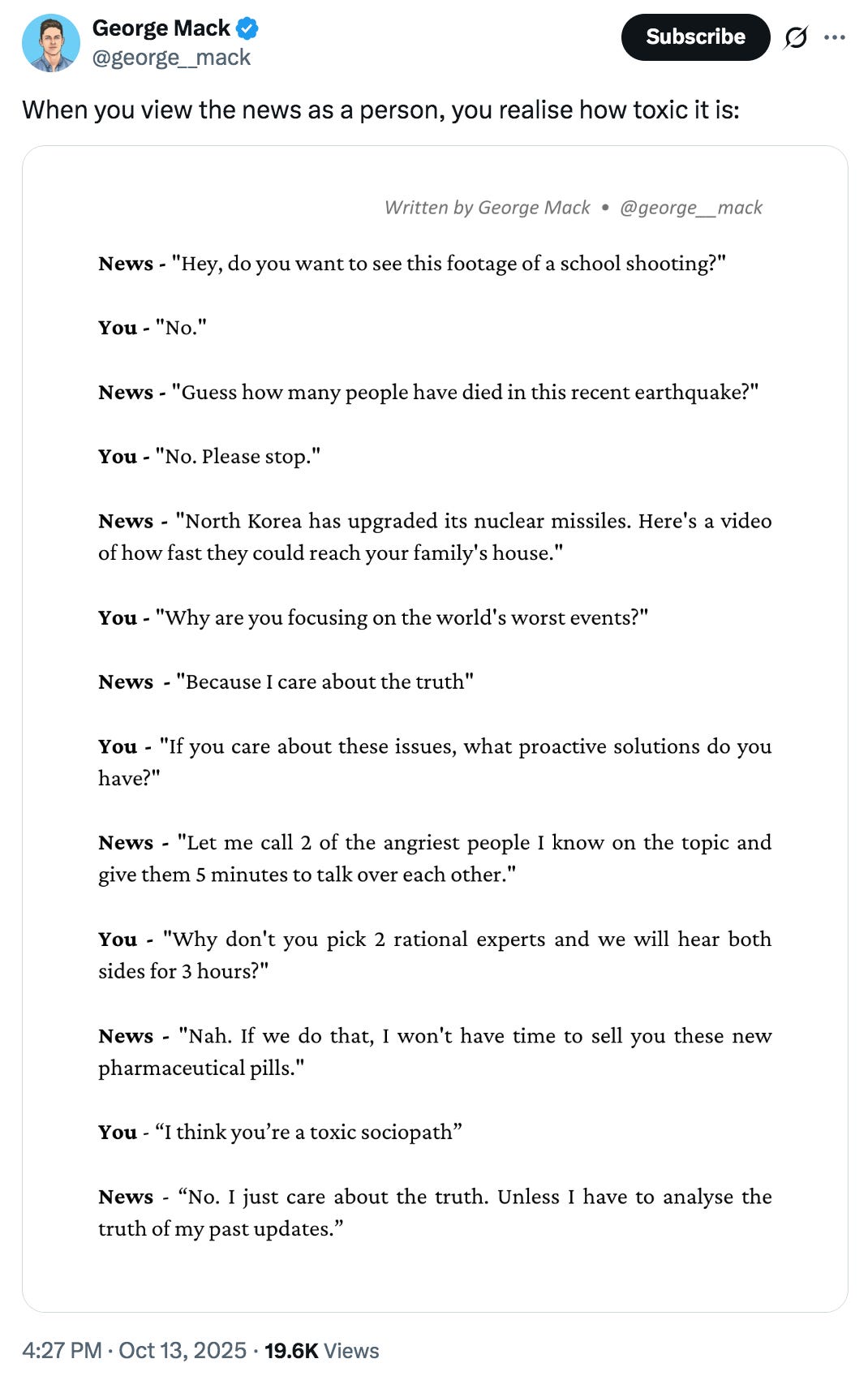
that’s all for this week’s edition of morning wood!
full disclosure — i’m still learning how to use my time well enough to produce as much content (hate that word) as i can for you.
i took a huge step this week by finally closing the chapter of being controlled by my phone. it’s been my primary source of distraction for years. in my journal, i literally described it as a ‘cancer in my life’ & it didn’t feel dramatic at all, lol.
but i’ve finally drawn the line.
like i mentioned earlier, i’m either willing to pay the cost of success, or i’m not.
my obsession with creating things has got to the point where now, i can’t even enjoy consuming content anymore. the whole time, no matter what i’m watching, i’m just constantly thinking of the things i could be creating instead.
is this sort of obsession healthy in the long run? probably not.
hell, i skipped lunch to write this — it’s not healthy in the short term either.
but i want to make this work so badly, man.
& i will.
~ liam (:
PS — @bigredtelephone is almost ready to launch! i can’t wait to show you.
“what you are not changing, you are choosing.”
~ Laurie Buchanan